


Visit Orange, the City of Princes
A former Roman colony in the Rhône Valley, Orange preserves two ancient monuments listed by UNESCO: the best-preserved ancient theater in Europe and a triumphal arch honoring the veterans of the Second Gallic Legion. To visit Orange, we take you through Roman stone, the history museum, and the old town, just 30 km from our campsite in the Vaucluse, in Bollène.
Orange in 5 Points
- The ancient theater of Orange dates back to the 1st century and is distinguished by its stage wall, unique in the West.
- The Triumphal Arch was erected in honor of the veterans of Caesar’s Second Gallic Legion.
- Both monuments are listed as UNESCO World Heritage sites.
- The museum of art and history is located in a 17th-century private mansion.
- From our campsite, it takes about 30 minutes by car to reach the center.
The Ancient Theater, a Unique Roman Vestige
This monument is among the finest legacies of Imperial Rome and houses the only stage wall in the West that is almost intact. This wall, 37 meters high and 103 meters long, served as a permanent backdrop for Roman tragedies and comedies.
Today, every summer it hosts Les Chorégies d’Orange, one of the oldest opera festivals in France. The visit includes an audio guide and an immersive projection, which recreate the life of the theater during its era of splendor.
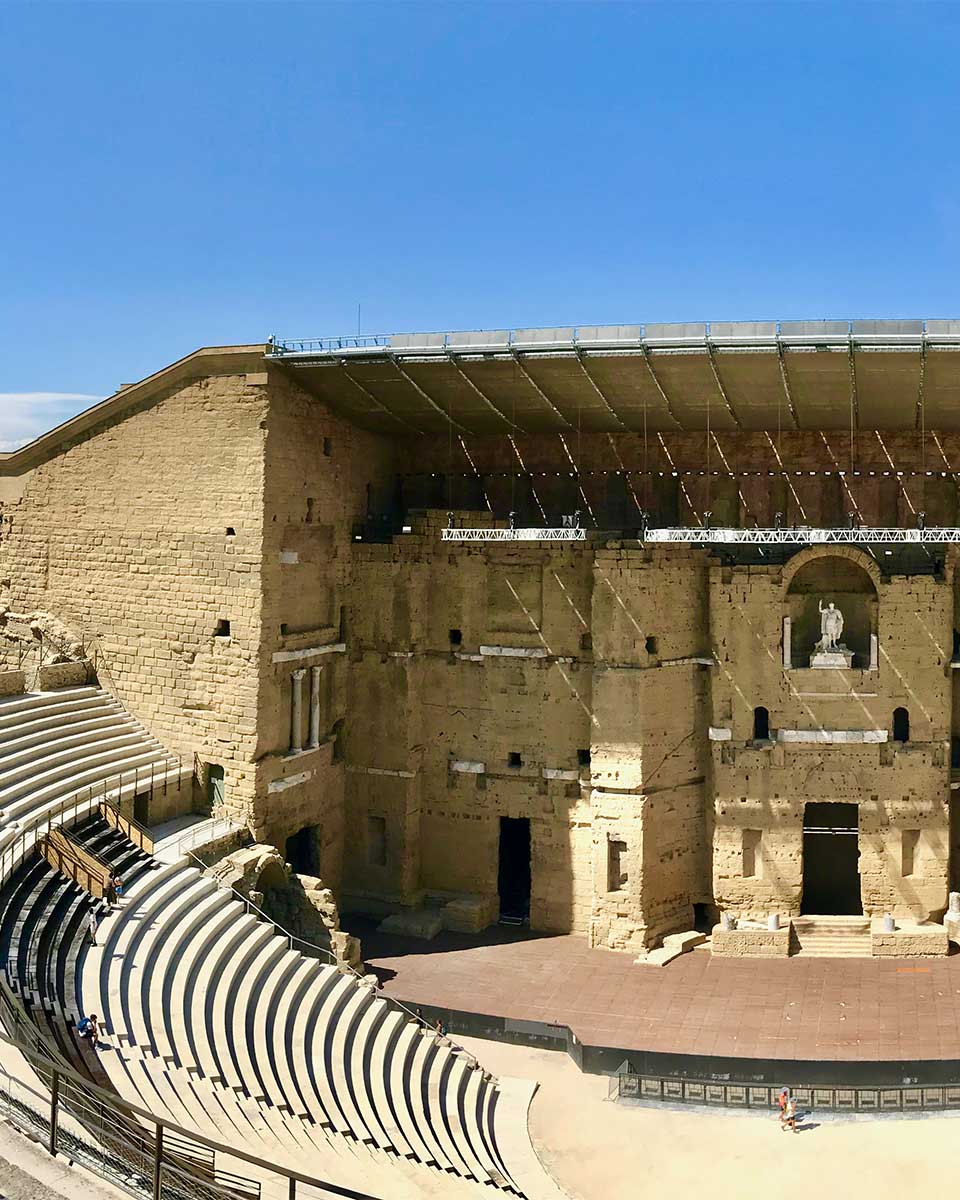
Good to know: the ancient theater is best visited early in the morning, when the low light illuminates the stage wall and the coolness makes the experience more pleasant. Our team advises enthusiasts to attend a night show, with the tiers filled just as they were in Roman times. An unparalleled immersion in Provence!

The Triumphal Arch and the Museum of Art and History
The Triumphal Arch of Orange stands at the northern entrance to the city, on the ancient Via Agrippa. It features three bays topped by a double attic, decorated with weapon trophies and bas-reliefs of captives.
A few minutes’ walk away, you reach the museum of art and history, housed in a 17th-century private mansion. Its collections trace the life of the city from Roman times to the 19th century, notably featuring the ancient land registries of Arausio, which are unique in the world.
A combined ticket for both sites
A single ticket gives access to the ancient theater and the museum of art and history, simplifying the visit. Allow about 3 hours to explore both sites at your leisure.
The museum offers valuable insight into the collections found during the theater excavations, with mosaics and sculptures presented alongside the remains themselves.
Saint-Eutrope Hill for the view
Just above the theater, Saint-Eutrope Hill offers a viewpoint over the city and the Rhône plain. A shaded park, remains of the castle of the Princes of Orange-Nassau, and a playground make it a pleasant family stop after visiting the ancient sites.
The climb takes about ten minutes on foot from the theater.


The Old Town and the Orange Lifestyle
Beyond the ancient monuments, the old town can be explored on foot, through shaded squares, fountains, and 18th-century facades. The Notre-Dame-de-Nazareth Cathedral, partly dating from the 12th century, is worth a detour, as are the central halls, which are lively on market days.
Here are a few ideas to extend your walk:
- Take a break on a terrace at Place aux Herbes, in the shade of the plane trees.
- Visit the Thursday morning market, one of the most vibrant in Haut-Vaucluse.
- Walk along the ramparts, of which a few medieval sections remain in the center.
- Climb up to Saint-Eutrope Hill Park for a picnic with a view.
The La Simioune Team’s Opinion: Our guests often combine a morning in Orange with a late-day trip to Mornas Fortress, very close to Bollène. Two complementary atmospheres, between Roman stone and a perched medieval castle.
Around Orange: Haut-Vaucluse, Ventoux, and Roman Villages
The city serves as an excellent starting point for visiting northern Vaucluse and the Rhône Valley.
A half-hour drive away, visiting Vaison-la-Romaine extends the discovery of the Roman world with another ancient theater and a perched medieval city. Further south, the hilltop villages of Ventoux and the monuments and castles of the Vaucluse complete a beautiful heritage getaway, set among stone, vineyards, and lavender in summer.

FAQ – Visiting Orange in the Vaucluse
What should I see in Orange first?
In Orange, don’t miss the ancient theater and its unique stage wall, the Triumphal Arch, and the museum of art and history. These 3 sites, listed or linked to UNESCO World Heritage, form the heart of the visit. Saint-Eutrope Hill and the old town can then be explored in a morning.
How much is admission to the ancient theater?
Admission to the ancient theater of Orange starts at €12 for an adult and €10 for a child, with a combined ticket including the museum of art and history. Reduced rates are available for students and large families; check these when purchasing online.
How much time should I plan for visiting Orange?
Allow about half a day to visit Orange at a good pace, meaning 3 hours for the theater and museum, plus an hour for the Triumphal Arch and the old town. A full day allows for a terrace lunch and a climb up Saint-Eutrope Hill.
Can I attend a show at the ancient theater?
Yes, the ancient theater of Orange hosts Les Chorégies every summer, an international opera festival, as well as other concerts and theatrical performances. Tickets should be booked several months in advance, especially for major operas. The setting of the stage wall remains a unique highlight in Europe.
Where can I park to visit Orange?
Several parking lots surround the historic center of Orange, notably the ancient theater parking lot and the one at Place de la République. Traffic is restricted in the old heart of the city; it’s best to arrive in the morning, especially on market days and during the high tourist season.
Can I visit Orange from the campsite?
Yes, from our campsite in Bollène, it takes about 30 minutes by car to reach Orange. Many of our guests visit the Roman city in the morning before returning to cool off in the campsite pool in the afternoon or heading off to other villages in Haut-Vaucluse.
Sources:
- Ancient Theater of Orange, your visit
- Provence Guide, Triumphal Arch of Orange
- UNESCO, Ancient Theater and surroundings and Triumphal Arch of Orange
Photo credits (Wikimedia Commons): Florent Pécassou (CC BY-SA 4.0), Poiesia (CC BY-SA 3.0), Daniel Clerc (CC BY-SA 3.0).